SARAJEVO SAFARI
Sarajevo Safari reconstructs the documented
practice of sniper tourism during the siege of Sarajevo (1992–96).

EVIDENCE 1: SARAJEVO GALLERY VIEW — Hero documentation of overall siege landscape and civilian routes
Sarajevo Safari translates forensic evidence—sniper positions, sightlines,
civilian routes, documented incidents—into a navigable spatial experience.
Visitors move through a mapped reconstruction of these positions, encountering
spatialized survivor testimony, environmental sound, and projected light overlays
tracing trajectories and impacts. The work does not reproduce the act of
targeting; it confronts the architecture of targeting, making visible the spatial
logic of violence and the complicity of spectatorship.
SOURCE MATERIAL
GIS data and satellite imagery of Sarajevo siege positions. Historical photographs and archival documentation of sniper positions. Maps of sightlines and civilian routes (OSINT methodologies). Contemporary images of memorial sites and contested urban spaces in Sarajevo.

EVIDENCE 2A: ARCHIVAL DOCUMENTATION — Historical photographs and siege-period archival materials
The archival documentation and GIS mapping form the forensic foundation for the installation. This evidence reveals not just historical positions, but the invisible geometries of violence—sightlines, trajectories, zones of exposure. In the installation space, these mapped coordinates become visible through light: projected vectors trace the documented sightlines, laser inscriptions mark the architectural geometry of control. Light functions as a forensic tool, making visible what was otherwise abstract data.
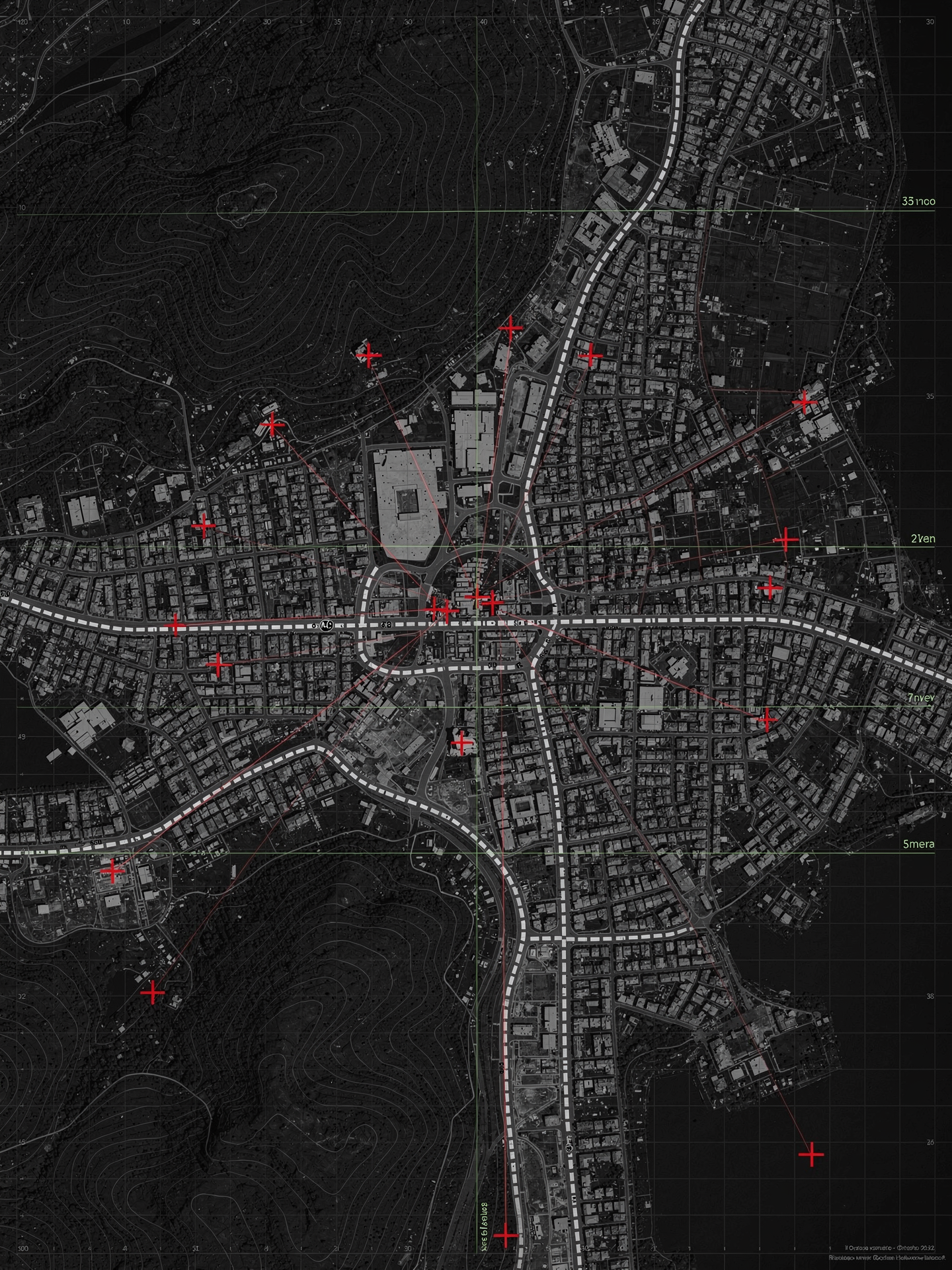
EVIDENCE 2B: SIGHTLINES & TARGETING MAP — GIS mapping of documented sniper positions and line-of-sight trajectories
2. CONCEPT DEVELOPMENT & DESIGN
VISITOR PATHWAY & INTERACTION DESIGN
- Spatial layout of the interactive installation (room-scale floor plan)
- User journey / visitor pathway visualization
- Interaction points: where visitors trigger audio, light, projection events
COLOR & AESTHETIC APPROACH
Projected light overlays: high-contrast sightline traces cutting through darkened space. Laser inscriptions: architectural geometry and trajectory paths. Color palette: restrained, forensic — grayscale with accent light. Spatial audio zones mapped to physical locations within the installation.

EVIDENCE 3: SNIPER'S VIEW — Reconstructed perspective from a documented sniper position, showing the full field of view and urban target zones
SNIPER'S PERSPECTIVE
The sniper's view is reconstructed to present the exact field of vision from a documented position, revealing the spatial logic and psychological impact of targeted urban violence.
This vertical reconstructed perspective shows the full field of view as seen from a sniper position, highlighting the scope of visibility and urban target zones. Through this perspective, visitors are confronted with the architecture of violence: how the city was transformed into a field of exposure, and how the act of looking became a tool of control. The installation uses this evidence to provoke reflection on the ethics of witnessing and the politics of spatial memory.