

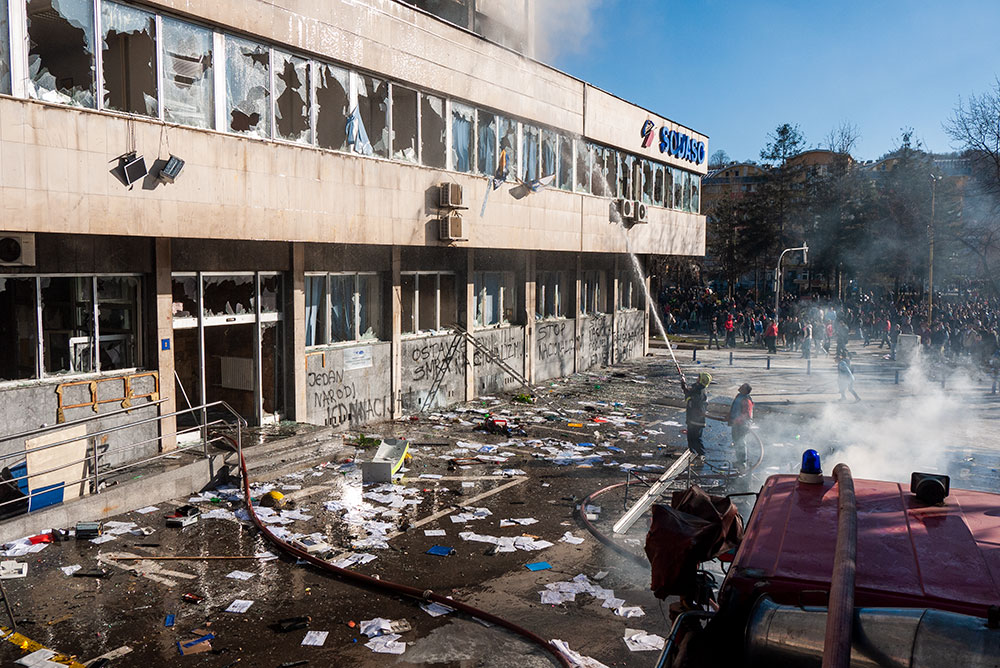
The 2014 unrest in Bosnia and Herzegovina began in Tuzla on 4 February, when workers and citizens rose up against the collapse of privatised factories, endemic corruption and mass unemployment. Within days it spread to Sarajevo, Zenica and other cities. I was in the streets from the first days, standing in front of government and cantonal buildings with a fisheye camera slung over my shoulder, trying to understand what was happening through the lens and through my body.
The protests were about very concrete things: ruined plants where people had spent their lives, unpaid wages, families pushed back into poverty after the promises of “transition”. People from different backgrounds stood side by side in the smoke, shouting the same names and demands, watching the same documents burn inside institutions that had stopped listening to them. As the days went on, the atmosphere thickened: sirens approaching, stun grenades cracking off the facades, tear gas rolling through alleys I thought I knew by heart.
I stayed as long as I could, moving between the crowd and the police lines, photographing workers’ councils, plenums, improvised banners and broken windows, but also the quieter moments when people simply stood together in front of buildings that suddenly looked very fragile. Those images became the series Unrest, and some of them were later published in The New Balkan Left. Struggles, Successes, Failures by Krunoslav Stojaković and Igor Štiks.
In my current research‑creation, these photos and the recordings I made are part of the archive I return to. They sit alongside material from bunkers, monuments and memorial factories, tracing a line from the streets of Tuzla in 2014 to the post‑Yugoslav architectures I work in now. The project grows out of that experience of being inside the crowd—feeling how sound, space and collective anger shape each other—and tries to find ways to transform that energy into forms of listening, remembrance and shared authorship.
The protests were about very concrete things: ruined plants where people had spent their lives, unpaid wages, families pushed back into poverty after the promises of “transition”. People from different backgrounds stood side by side in the smoke, shouting the same names and demands, watching the same documents burn inside institutions that had stopped listening to them. As the days went on, the atmosphere thickened: sirens approaching, stun grenades cracking off the facades, tear gas rolling through alleys I thought I knew by heart.
I stayed as long as I could, moving between the crowd and the police lines, photographing workers’ councils, plenums, improvised banners and broken windows, but also the quieter moments when people simply stood together in front of buildings that suddenly looked very fragile. Those images became the series Unrest, and some of them were later published in The New Balkan Left. Struggles, Successes, Failures by Krunoslav Stojaković and Igor Štiks.
In my current research‑creation, these photos and the recordings I made are part of the archive I return to. They sit alongside material from bunkers, monuments and memorial factories, tracing a line from the streets of Tuzla in 2014 to the post‑Yugoslav architectures I work in now. The project grows out of that experience of being inside the crowd—feeling how sound, space and collective anger shape each other—and tries to find ways to transform that energy into forms of listening, remembrance and shared authorship.
More here